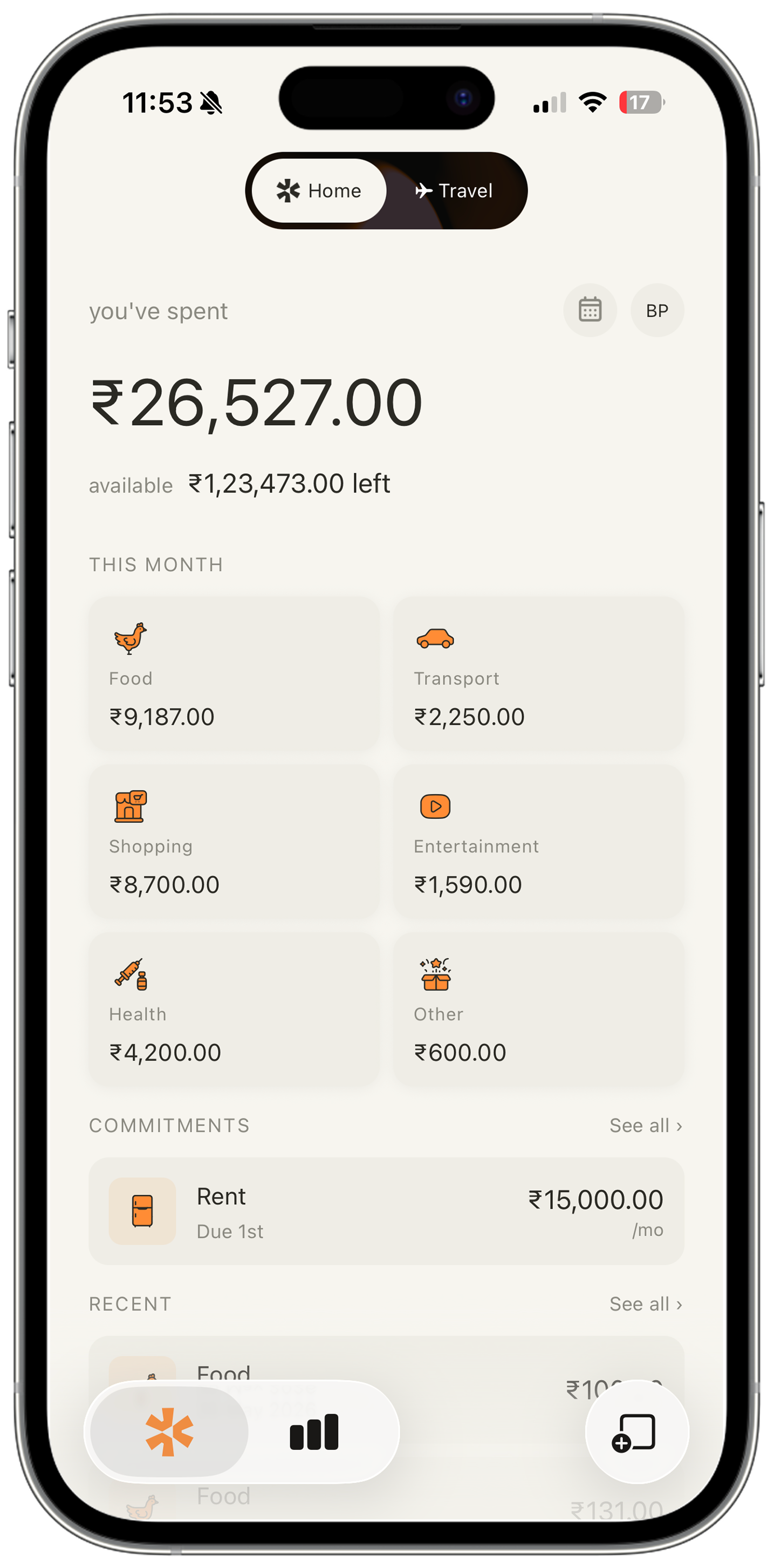
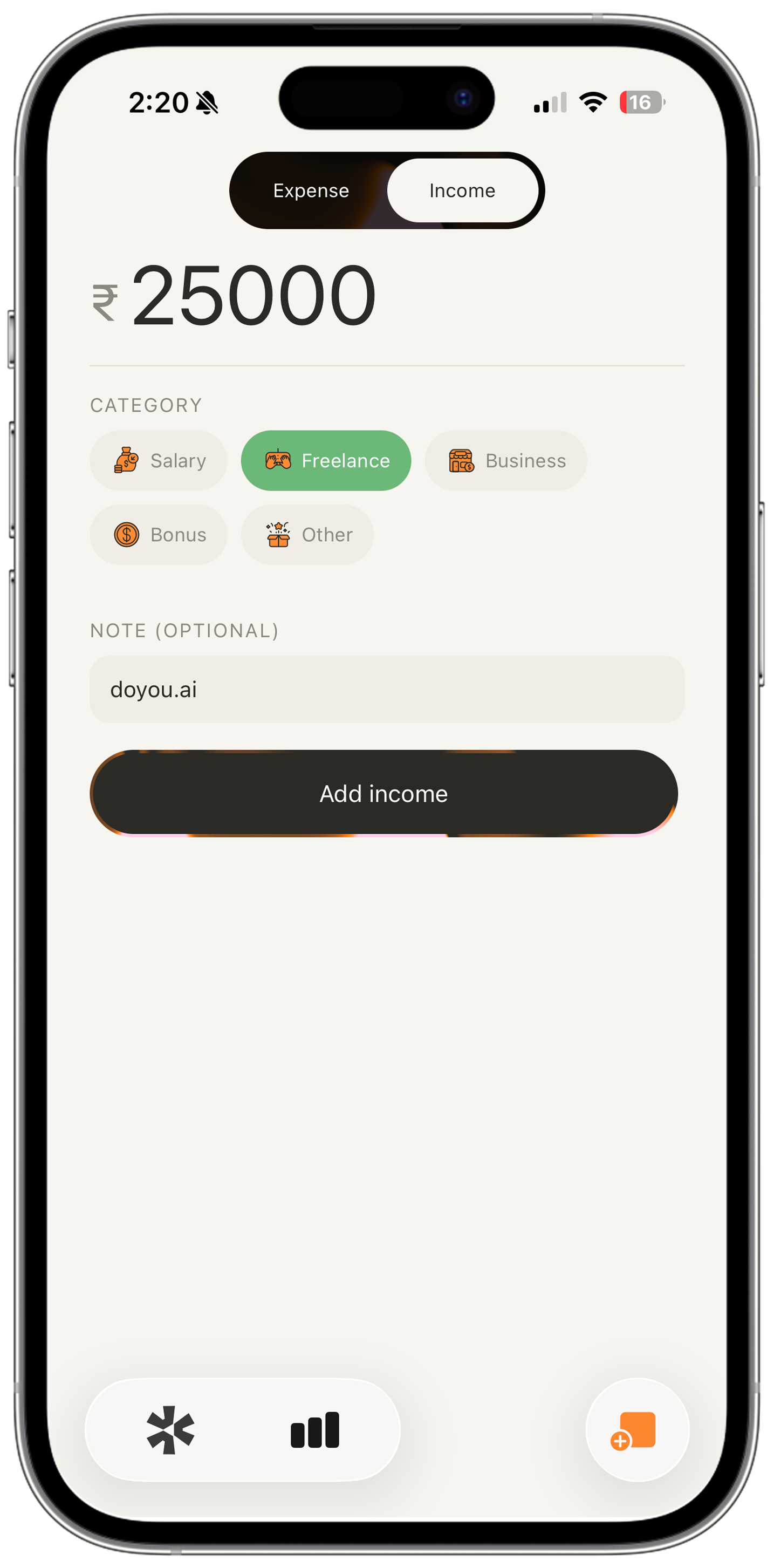
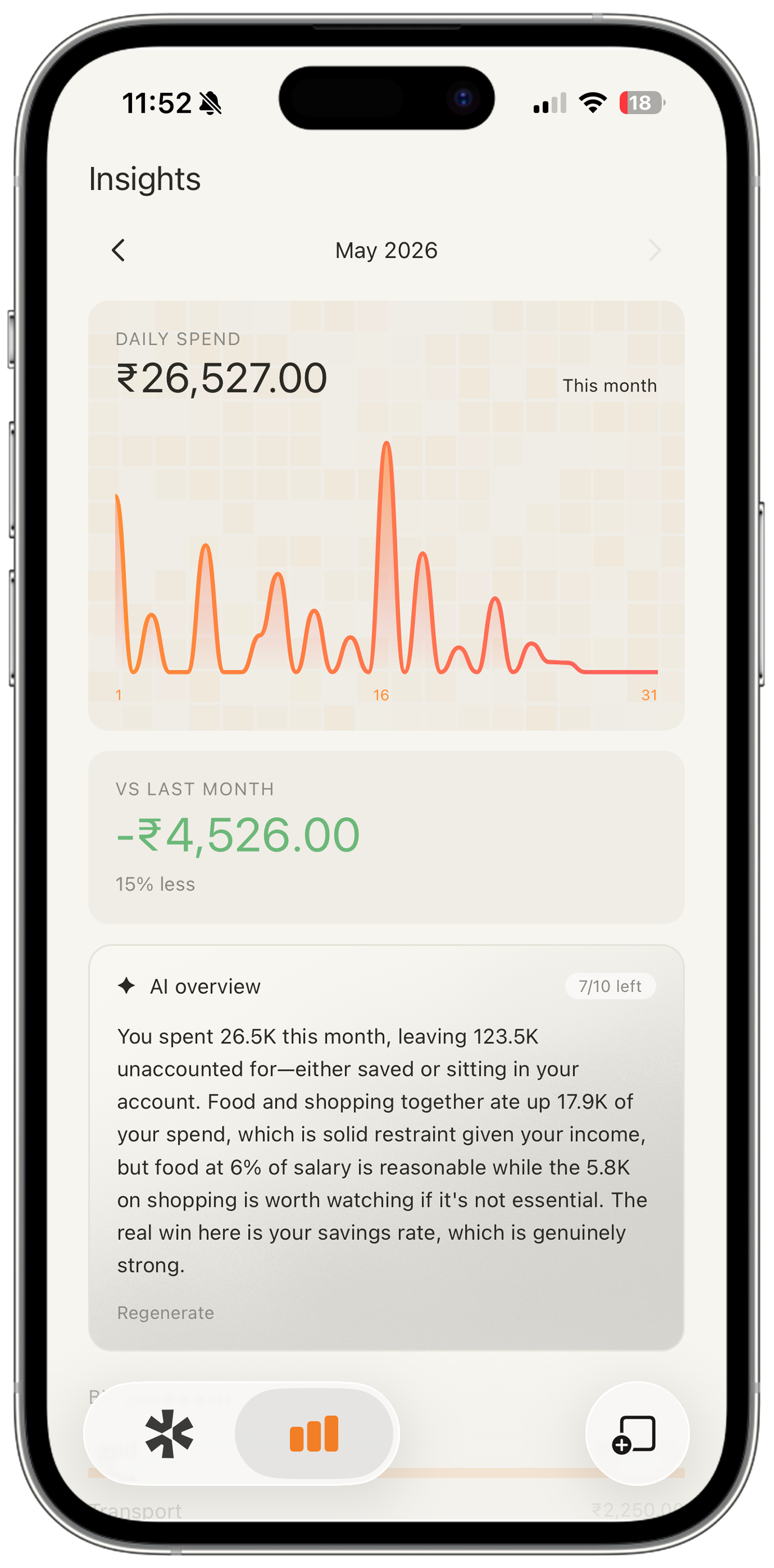



Baki started from a personal frustration: every budgeting app I tried told me how much money I had, not how much I could actually spend. The difference matters. If you earn ₹80,000 a month but ₹45,000 is already committed to rent, EMIs, and subscriptions, your real spendable balance is ₹35,000. Baki shows you that number, prominently, before you open your wallet.
The Core Idea
The hero metric in Baki is the available balance:
available = salary − locked commitments − spent this month
Commitments are recurring expenses you've pre-declared — rent, EMIs, subscriptions. They're "locked" — they reduce your available balance before you start the month, so daily spending never collides with bills you've already promised to pay.


Tech Stack
| Concern | Choice |
|---|---|
| Framework | React Native 0.84 (bare, no Expo) |
| Language | TypeScript (strict) |
| State | Zustand + MMKV |
| Navigation | React Navigation 7 (native stack) |
| Animations | Reanimated 4 + Skia |
| Database | Supabase (Postgres + RLS + Realtime) |
| Auth | Supabase Auth + Google Sign-In + Apple Sign-In |
| Payments | RevenueCat |
| Push | Firebase Cloud Messaging |
| Localisation | i18next (30+ languages) |
Bare React Native was a deliberate choice. Full native access — custom modules, the New Architecture (Turbo Modules + Fabric), no Expo abstractions between me and the platform.
Add Expense
The add expense screen uses a spectral wave animation as the background — two animated sine waves blended with colour stops. Category and payment method are selected via chip rows, no modals. Optimistic updates hit Zustand immediately; Supabase syncs in the background.


Split Expenses
One of the deeper features is a Splitwise-style group expense system. Groups have members, expenses, and balances with five split modes:
- Equally — divide by selected members
- Exact amounts — enter per-person amounts, remainder shown
- Percentage — enter per-person percentages
- Shares — stepper-based ratio splitting
- Adjustment — base split with signed per-person offsets
Each split expense also creates a linked entry in the main expense store so it flows into your category grid and reduces your available balance.

AI Trip Planning
The travel mode includes an AI-powered itinerary generator. Describe a trip in natural language — "5 days in Tokyo for food and culture, ₹1.5L budget" — and the AI generates a day-by-day plan with estimated costs. Pro users can one-tap import it as a Baki trip, automatically creating destinations and seeding daily budgets from the estimates.
The itinerary generation runs via a Supabase Edge Function (GPT-4o), with the user's JWT forwarded for auth. Exchange rates are cached at trip creation so historical data stays accurate as rates shift.


Shared Element Transitions
The intro screen cycles through 30 languages showing "balance" in each — Arabic, Japanese, Hindi, Russian — landing on "Baki". The logo transitions via a shared element animation to the welcome screen using Reanimated 4's sharedTransitionTag.
Reanimated 4 has ENABLE_SHARED_ELEMENT_TRANSITIONS as a static C++ compile-time flag, enabled via package.json:
"reanimated": {
  "staticFeatureFlags": {
    "ENABLE_SHARED_ELEMENT_TRANSITIONS": true
  }
}
This required a full rebuild (pod install + clean build), but the result is a native-quality shared element transition without any third-party library.
Localisation
The app ships with full i18next support across 30+ languages, with locale-aware number formatting. Indian users get the lakh/crore system (₹1,23,456), global users get standard formatting. The language detection is automatic on first launch.
What I Learned
New Architecture is ready. RN 0.84 drops legacy architecture entirely. Every module must be Turbo Module compatible. The ecosystem has caught up — all the libraries I needed had New Architecture support, and the performance difference is real.
Zustand + MMKV is the right pairing for offline-first. Zustand for in-memory state, MMKV as a synchronous persistence layer, Supabase for truth. No sagas, no thunks, no boilerplate.
Soft paywalls convert better. The paywall only shows after the user has seen real value — after 100 expenses logged, or when they try to view history older than a month. Hard paywalls on first launch convert at ~1%. Soft paywalls after value is demonstrated convert significantly better.
RevenueCat is worth it. Subscription state management, receipt validation, promotional entitlements, and a dashboard with cohort data — all without building any of that infrastructure yourself.